Let us begin at the end. The epilogue of the play ‘Collect & Save – Save & Collect’, written and performed by Carmen van Mulier and Mathieu Wijdeven. It is a starting point for reflecting on the fleetingness of theatre, memory, and family archives. What happens to books, tapes, or instruments when no one remembers their story? Are they still an archive, or just forgotten objects? In this performance, the stage becomes an archive of personal items, dreams, and memories.
What follows are fragments of scenes, conversations, and reflections that move between past and present – an invitation to explore what we choose to hold on to, and what we allow to disappear.
EPILOGUE
Carmen walks up the stairs, Mathieu joins her.
Speaker 3 [00:19:00] ... playing with the fleetingness of time. But you also see us performing in the archive, and then you have to figure out – okay, first this happened, then that.
Speaker 2 [00:19:08] Yeah, and we found something really interesting. We realized that theatre, memories, and dreams have something in common. With memories too, you have to use your imagination to think of something that happened.
(…)
Speaker 3 [00:09:07] But it's interesting that we had a bunch of books, tapes, music. There were also instruments on the stairs, newspapers, and plays. And we realized – okay, it's nothing when it's just lying there. You can look at it and see nothing. But we also literally had flashlights. When you shine a light on it, take something out, talk about it, tell a story, or even just read it out loud – then suddenly you're in the past. You're in a story. You're in imagination.
And then you immediately have... something interesting going on.
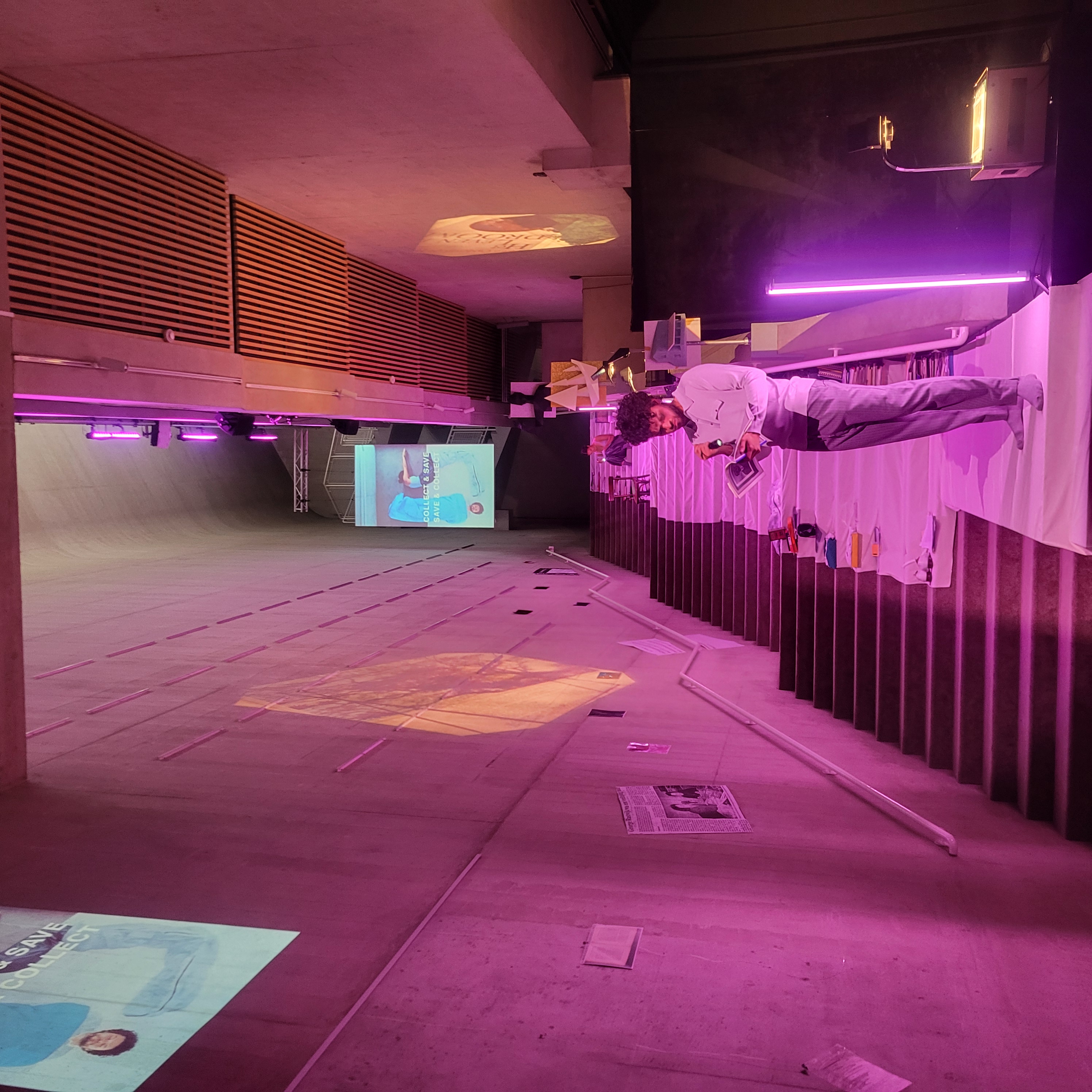
Something interesting begins to stir. In ‘Collect & Save – Save & Collect’, she reflects not only on her own personal theatre archive, but also on the archive of her father. Around the ninth minute of the play, personal and inherited stories start to intertwine, stirred by a hidden attic…
9TH MINUTE
C sits on the stairs, pulling the sleeping bag over herself.
Reflecting on Carmen’s father’s attic...why not include the WhatsApp exchange between Carmen and Mathieu that started it all? This tiny conversation, a seed of an idea, became an anchor in time. Can you start to see how it’s all connected? Carmen once felt deep shame about her father’s attic. But eventually, she and Mathieu went there together. Conquering shame, and maybe even a bit of fear. Facing not just the archive, but what it held.
Our story ends at the beginning: the prologue of the play. The text was written in 1913 by Mathieu’s great-great-grandfather from Suriname, G.G.T. Rustwijk. A reminder that time, power and archives are always entangled. Or that fleetingness is never an ending, but an ongoing invitation to return.
PROLOGUE
Carmen plays intro The clock starts: 15 to 1 countdown video C plays synth Sakamoto Theme from sleeping bag. Mathieu with small light in sleeping bag
Fragments from: ‘Collect & Save – Save & Collect’ performance TRACK: Sample, Scratch & Rewind, September 4-7, 2024 Theatre Rotterdam Panel talk ‘Performing Family Archives’ Sanne Rotmeijer, Carmen van Mulier, Mathieu Wijdeven Keeping/Discarding seminar, January 16, 2025 Leiden University WhatsApp Conversation, Summer 2024
Story by Carmen van Mulier, Mathieu Wijdeven and Sanne Rotmeijer.
Carmen is a Rotterdam based actress, singer and director. She graduated from the Academy of Dramatic Arts in Amsterdam in 2017. She also works as an Artist Researcher at the Centre for the Arts in Society (LUCAS) in the ERC-project ARTIVES.
Mathieu is a theatre maker and artist whose practice operates at the intersection of archives, imagination, and (post)colonial memory. In his performances and installations, he explores how artistic interventions can activate hidden or marginalised histories. In 2022, he was awarded the Dutch Theatre Writing Prize (Toneelschrijfprijs) for his work. Sanne is a researcher and a lecturer at the Leiden University Centre for the Arts in Society. Her work explores the intersections of popular culture, diversity, and postcolonial urban life, with a current focus on how performance artists with Dutch Caribbean and Surinamese roots reimagine heritage, belonging and identity in postcolonial Rotterdam.