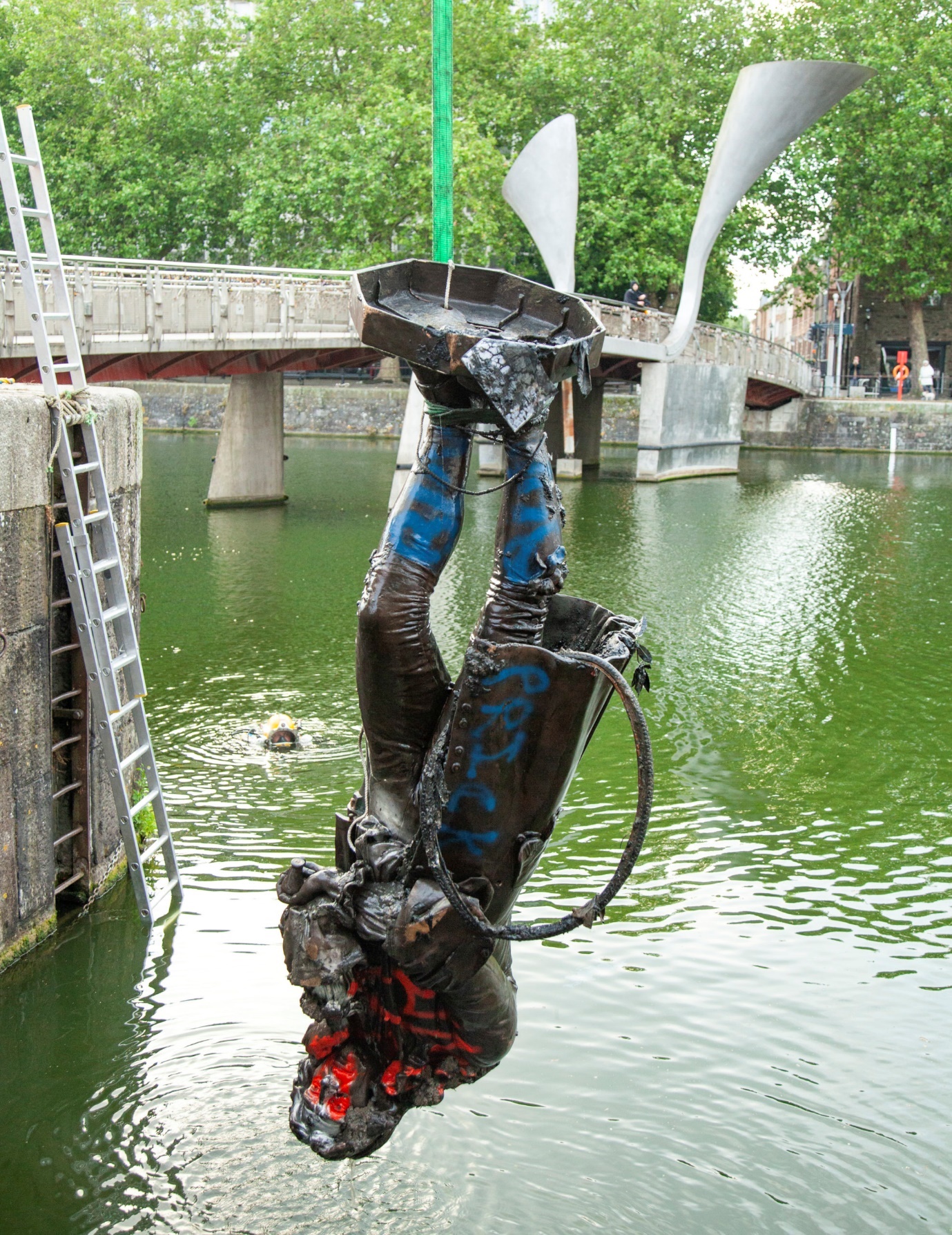
As the object was being challenged and unsettled, so too was Bristol. By the time the statue was toppled, graffitied, dragged across the city streets, and dumped into the sea, it now represented an emerging desire to connect the city to wider international anti-racist struggles (especially Black Lives Matter and similar actions against statues, such as the ‘Rhodes Must Fall’ campaign). Now at the bottom of the harbour from which many slave trading ships would have set sail, Colston was eventually rescued and preserved in a museum, but had accumulated new traces and layers of meaning. The statue was now displayed horizontally: damaged and covered in paint.
Meanwhile, the empty plinth, still standing in the square and freed of its burden, began to take on an afterlife. Protest placards were left leaning against it, a slave ship was mapped out in front of it, a statue of Jen Reid – a black female protestor raising her arm in a Black Power salute – was placed on top without permission (before being taken down by the council). The empty plinth became a platform imbued with new significance as protestors began to use it as a gathering point and a podium from which to speak. Although the materiality of the podium stubbornly held onto some of the hierarchical and dominating intentions of the original statue, restricting access to those less able to climb on top (echoing the controversial monument to the Peterloo massacre in Manchester: a set of circular steps long criticised by disability rights activists in the city, who point out that those cut down by the army in 1819 would themselves have struggled to get to the top to speak (Pring 2021).
This new artefact of an empty plinth also sparked wider debates around archival objects in public space. For sociologist and journalist Gary Younge, it raised questions around whether we should have statues at all. After all, who gets to decide which histories are written in stone and ‘projected into the forever’ (Younge 2021)?
But perhaps there’s an answer in what Mapuche scholar Claudio Alvarado Lincopi calls ‘saturation’. In 2019, the Chilean uprisings in Santiago against Pinochet’s dictatorship-era constitution targeted a statue of Spanish conquistador and city founder Pedro de Valdivia. Rather than topple the statue, however, the protestors aimed to ‘saturate’ its meaning. The statue was painted and redressed in Mapuche symbols and clothing, modifying its aesthetics and ‘staining’ its whiteness. These actions upturned dominant narratives in the city and instead conveyed ‘multiplicities of meaning’. In contrast to Younge, history is not set in stone, never petrified, and it can always be reframed. In this moment of saturation, not only was the ‘narrative of whiteness engraved in [Santiago de Chile’s] monumentality… made visible and explicit’, but ‘it was questioned and challenged’ (Casagrande & Alvarado Lincopi 2022).
Story by Samuel Burgum.
Sam is a critical urbanist based at the Urban Institute, University of Sheffield. He is co-corresponding editor at CITY and author of Squatting London: the Politics of Property (Pluto Press, 2025). More information here.