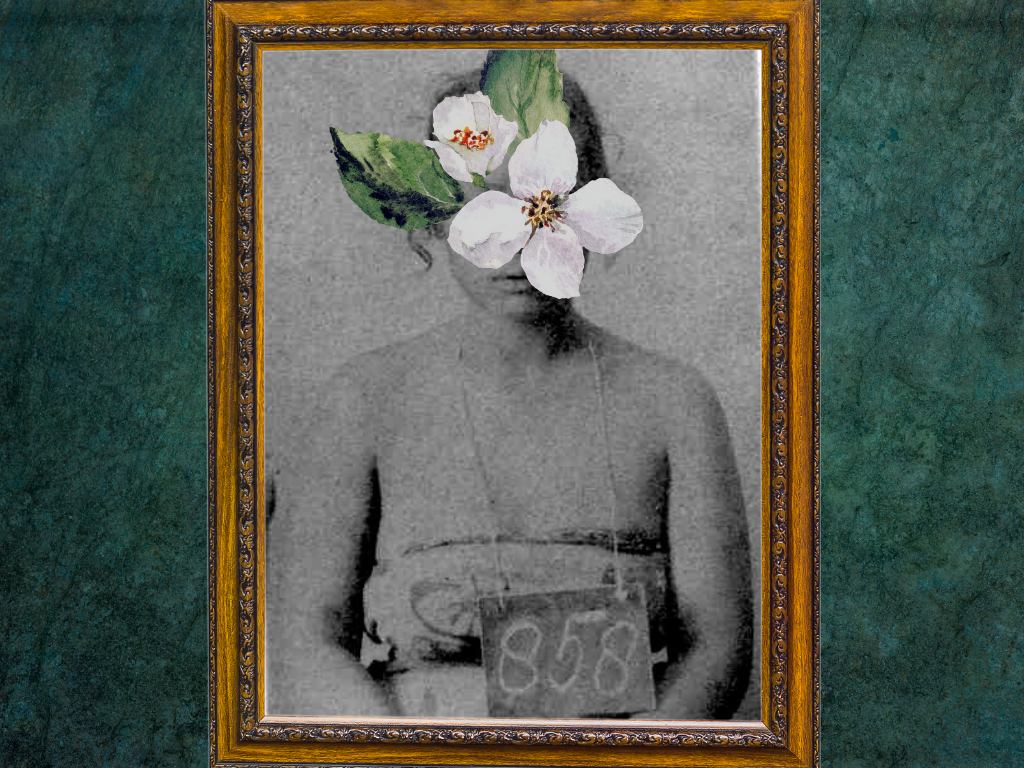
This identity photograph of my great-grandmother, Semoe, was taken during the period of Javanese Indentured Labor in Suriname. According to public records, she was 28 years old when she left Semarang, Java. After two months at sea, she arrived in Suriname on June 25th, 1912, to work on the coffee plantation Voorburg. I remember the first time my family and I found this photograph in the online database of the National Archives of the Netherlands. Her eyes were haunting; there was sadness in them, yet we felt a deep joy in connecting our family history to her face. In her features, I saw the eyes of my mother, aunts, and cousins.
In many Asian cultures, family photos are placed on altars or walls to honor ancestors. But what do you do when a photograph is steeped in colonial violence? When I present my research, I often show this photograph to commemorate and remind others of how colonial and family archives intertwine-- how history is both documented and erased. But for this exhibition, I hesitated, as it feels more permanent. Did she ever consent to this photograph?
For this reimagination of her photograph, I chose to conceal her face with kembang melati (jasmine flowers), which hold spiritual significance in Javanese culture. These flowers are used to honor ancestors and as protection against evil spirits.
By covering her face, I ask: how do we, as artists, researchers, and descendants, engage with family archives rooted in colonial violence? What should remain private, and what should be shared? How can we avoid romanticizing the past or perpetuating the colonial gaze?
In 2023, I began working on Re/Presenting Europe: Healing the Afterlives of Colonialism. Within this project I explore how colonial systems continue to shape the lives of Javanese indentured laborers and their descendants in the Netherlands and Suriname, and how they navigate healing through storytelling and artistic practices. I discovered that the silence in my own family’s history reflects a larger absence in the collective memory of Javanese Indentured Labor.
This system of Javanese Indentured Labor began in 1890 after the abolition of slavery and the end of Chinese and Indian indentured labor, as the Dutch sought new ways to sustain the plantation economy. Since the Indonesian Archipelago was already under Dutch rule, transporting laborers from Java was easier than from British-controlled India, giving the Dutch greater control over recruitment and conditions. Growing up in Suriname, I was taught that Javanese 'migration' was voluntary, an escape from poverty for a better life. The narrative focused on gratitude for their sacrifices and the diverse culture they brought to Suriname. However, my research revealed that stories of violence, kidnapping, and oppression on the plantations were largely absent.
Colonial archives often reduce individuals to administrative data, dehumanizing records that strip away personal stories and micro histories. Through my research and conversations with family, I learned more about my great-grandmother’s experience. According to my aunt, she never intended to come to Suriname and had no idea where it was. Her last memory of Java was at a market, only to wake up on a ship, disoriented. She arrived sick and required hospitalization. She worked hard on the plantation but never spoke of Java, it made her sad and homesick. As a researcher, I often feel a dilemma: when do we respect the silence of ancestors who refused to speak, and when does silence perpetuate erasure?
Realizing that this photograph was not taken with the intention of becoming a family picture or archive, it suddenly gained a new meaning. Do we keep it or discard it?
In Javanese Islamic traditions, we visit and clean the graves of loved ones before the start of Ramadan. This year, I visited the plantation and house where my great-grandmother once worked and lived, I retraced her steps and imagined spending time with her. Though I couldn’t visit her grave, my aunt told me it is covered with kembang melati. Every time I smell the flowers now, I feel her presence, her silence, her longing for home, but also the love and care she left behind in the generations she made possible.
Story by Jonathan Tjien Fooh.
Jonathan is a Surinamese cultural anthropologist and writer based in the Netherlands. His work explores colonial histories and anti-colonial movements across the Caribbean and Indonesian Archipelago, combining ethnography, critical archives studies, arts-based methods, and queer studies. As part of Re/Presenting Europe, he researches embodied healing practices linked to Javanese Indentured Labour and teaches at the Athena Institute (VU Amsterdam).