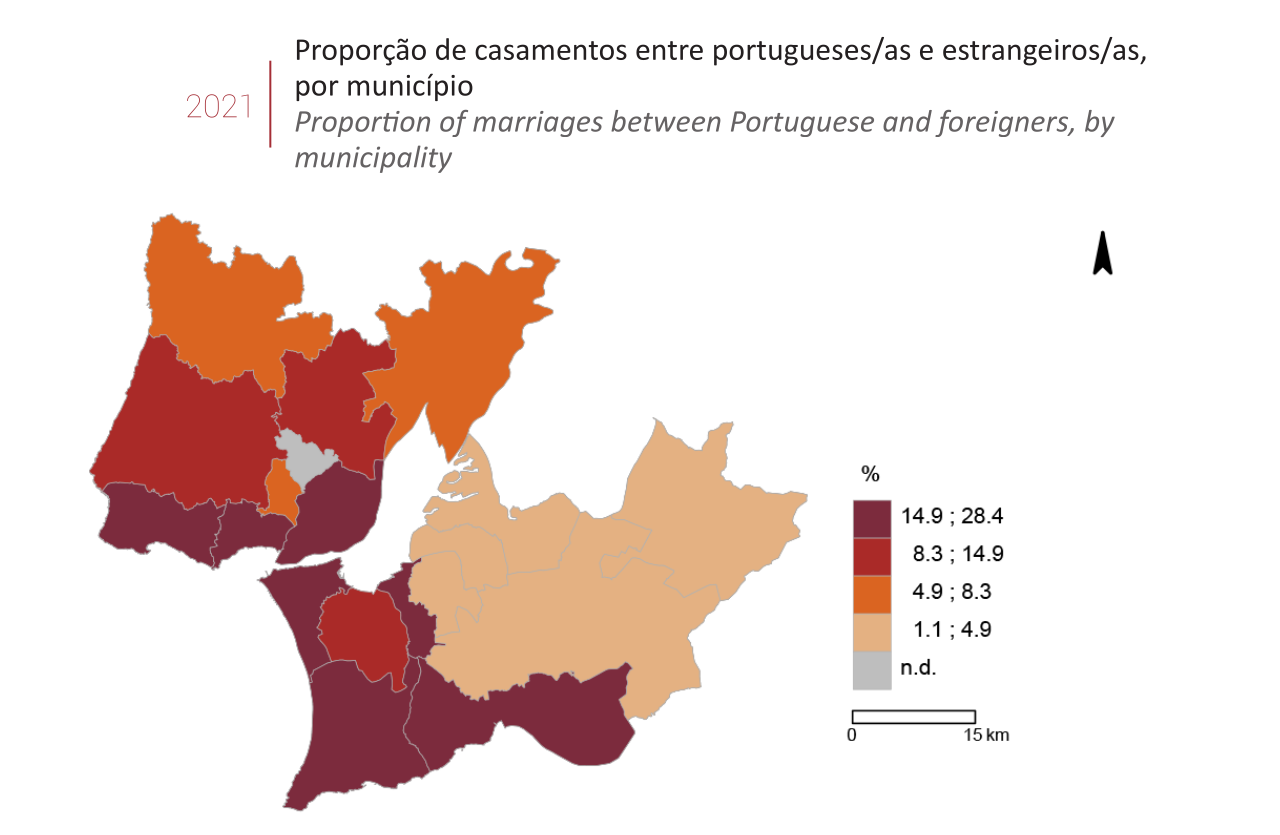
Certificates of all sorts — birth, death, marriage. Residence permits, citizenship attributions... Public administration institutions issue and store all kinds of official documents that seem to form detailed and thorough archives of personal trajectories which, in turn, generate certain stories and certain imaginaries of the spaces these individuals live in. Statistical data reports published by governmental agencies and institutes transpose these data points into graphs and maps visualizing local demography through the lens of a series of duly selected economic and social indicators. This is the case, among many other, of the annual reports Lisbon Metropolitan Area in Figures published by the Portuguese National Institute of Statistics in which the readers can discover, for example, which municipalities stand out in terms of the number of weddings between Portuguese citizens and foreigners. Shades of beige, orange, and red indicate the relative intensity of such occurrences in each administrative territory. Has my own wedding contributed to filling in the contours of the Lisbon municipality with a darker tone of red? The years I lived in Lisbon as a Polish immigrant and then naturalized citizen must be recorded in the archives. At least in some way.
But in what way? And what are the other ways that a traditional archive discards? And how do such data-driven and archive-based imaginaries of the city as the one I came across in the statistical report clash with but also inspire alternative imaginaries? These were the questions popping up in my mind when reading Os Vivos, o Morto e o Peixe Frito [The Alive Ones, the Dead One and the Fried Fish] by the Angolan writer Ondjaki, a book published in 2014 and classified on the back cover as "a theatre play as if it was a novel. Or the other way round." It is staged in an imaginary Lisbon, described more as a sensation of a certain lived experience than an actual coordinate on the world map, and its plot is interwoven by scenes of conviviality among 'lisboetas', residents of Lisbon, with ties of belonging to the different African countries with Portuguese as their official language. Time of action – the day that the Angolan national team plays against the Portuguese team in a football championship. As highlighted by several characters, without watching the game, it would be impossible to guess who is winning. "Here in our neighbourhood, the cheerful shouts do not mean anything... It can be as much Portugal as Angola winning." (229)
The spaces where the action takes place are highly symbolic despite the Portuguese capital city being explicitly identified in the text. The opening scenes take place in the building of a public administration institution called Migrações com Fronteiras [Migrations with Borders], a clear reference to the notorious Serviço de Estrangeiros e Fronteiras [Foreigners and Border Control] which was dissolved by the Parliament in 2021. While public administration institutions tend to be seen and experienced as a space of transit, with people coming and going, Ondjaki’s “Migrations with Borders” do play an identity-building role. The conversations in the queue are often continued in the nearby "Schengen Bar" whose name ironically refers to the abolition of border controls within the European Union while many of the bar's customers face stricter migration regulations and external border controls. These moments of sharing reveal traces of the visitors' personal histories that map physical and affective trajectories between the different spaces of the so-called (and contested) Lusophone world. “Migrations with Borders” symbolically represents, thus, the lack of recognition – by public policies, administrative services, and their archives – of a Lisbon identity formed and shaped through a significant part of its migratory past and present.
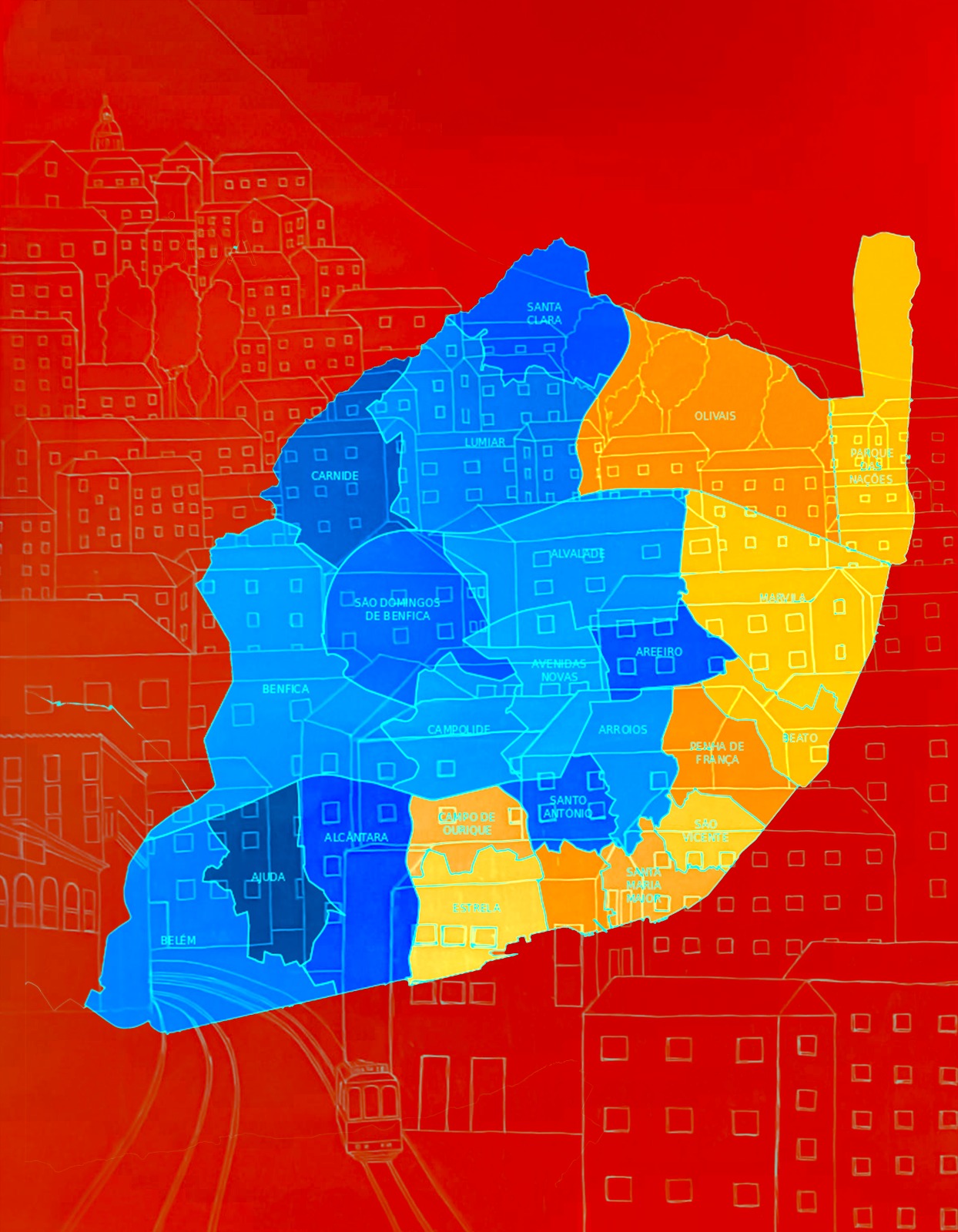
Throughout its acts/chapters, Os Vivos, o Morto e o Peixe Frito sketches imaginary maps of Lisbon which allow its readers to explore the streets and hills of the Portuguese capital from a different perspective. A perspective that, on the one hand, invites to denounce the inequalities and prejudices which make a considerable part of the population sense their belonging to the city as inherently conditional. On the other hand, a perspective that captures the resilience of African and Afrodescendent communities in claiming their right to the city and draws an urban poetics of relation without fixed, rooted coordinates. While reflecting on how to visualize the productive tension between the power of narratives, such as the one by Ondjaki, to map urban imaginaries of affect vis a vis institutional efforts to quantify and represent the character of the city as captured in its archives, I contacted a local artist to try and work further with these frictions.
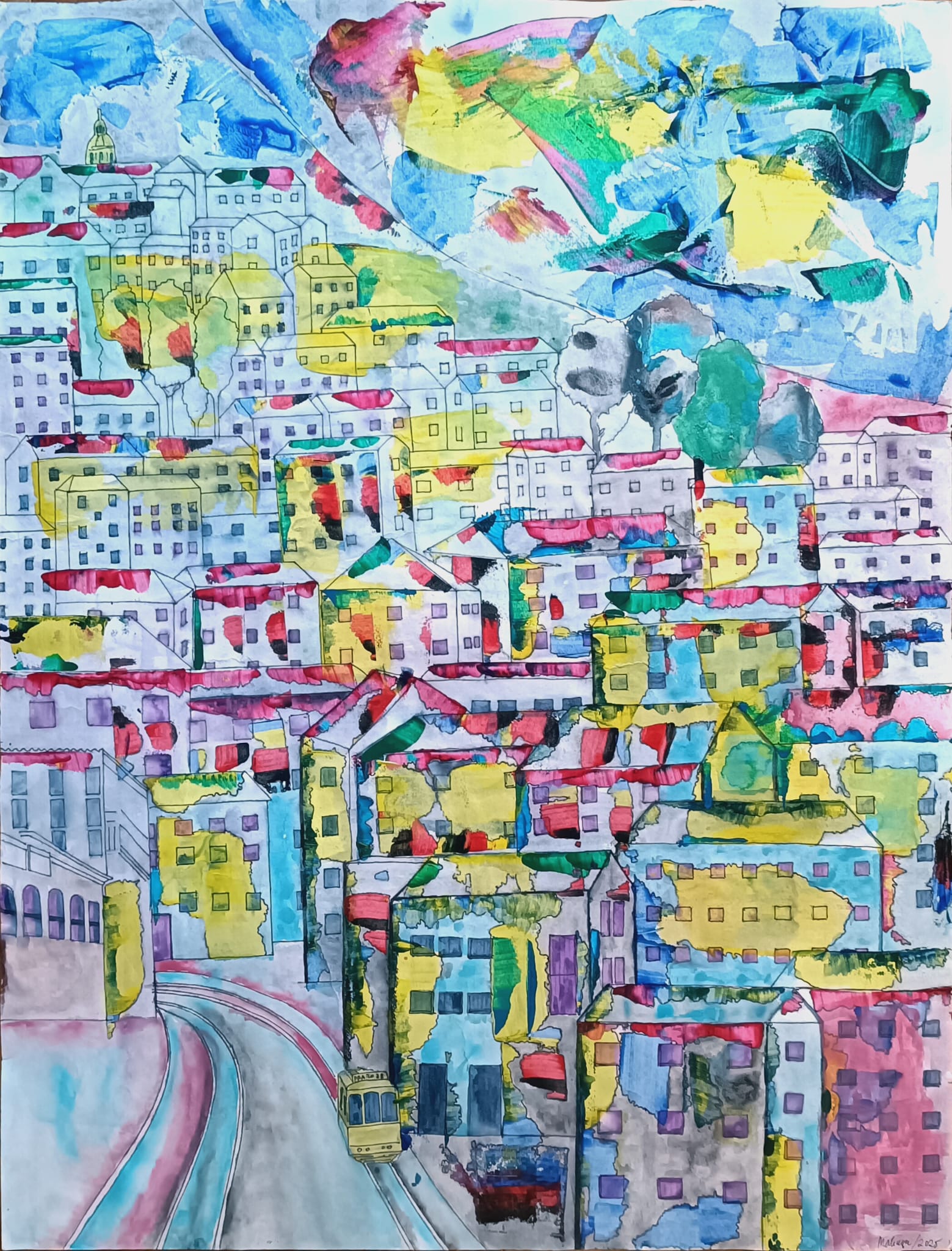
Malenga’s imaginary maps of Lisbon at the same time traverse and are inscribed within local and transnational cartographies. The windy contours of streets, houses, iconic trams, and opaque waters of the Tagus delta cannot be neatly superposed on the administrative borders of the city’s freguesias. Rather they emerge as thin white lines from below as if trying to bend the official vision of what Lisbon is or should be. When liberated from the constraints of the local map, new less obvious maps emerge. Painted with bright watercolors, the facades and rooftops become the canvas for alternative cartographies. Irregular patches of light and shadows create an organic impression of a dynamic urban landscape and, when zoomed in, reveal contours of different maps – suggestions of countries and continents that have been shaping Lisbon’s past, present, and future. As indirect, multi-layered, and often opaque representations, literary and visual narratives form alternative records of mobility, conviviality, and belonging that can compose a more affective archive of contemporary Lisbon.
Story by Kamila Krakowska Rodrigues, illustration by Malenga.
Kamila is a university lecturer at Leiden University Center for the Arts and Society (LUCAS). In her research combining cultural analysis and creative participatory methods, she addresses identity negotiations in arts and cultural practices in the globalized Portuguese-speaking world, with a special focus on African and Afrodescendant communities.
Malenga is a Lisbon-based sculptor, painter, and musician. His artistic trajectory started with his upbringing as a Makonde – an ethnic community with a rich tradition of sculpture – in the north of Mozambique. In 2007 he was awarded a scholarship to study at Ar.Co (Center for Arts and Visual Communication) in Lisbon and was an intern at the Faculty of Fine Arts at the University of Porto. His artworks have been exhibited in Portugal and abroad in collective and individual exhibitions. A selection can be seen at his Instagram account.